Strength training is the fastest-growing modality across gym demographics right now. Women and older adults in particular are showing up for it, and group fitness schedules that ignored resistance training five years ago are adding it fast.
The demand signal is real. HFA’s 2026 benchmarking data confirmed it. But the programming question — what actually happens inside those classes — is where most facilities fall short.
The gap isn’t that gyms aren’t offering group strength classes. It’s that most of those classes aren’t doing what strength training is supposed to do. Members are training, but they aren’t building anything.
What Most Group Strength Classes Actually Are
Walk into a typical group strength session at most clubs and you’ll find one of a few formats.
The most common: a full-body circuit, usually timed intervals, with moderate weights, constant movement, and a coach calling out rep counts from the front. The class is busy. It looks productive. Members are sweating.
But the load is the same as it was six weeks ago. The movement pattern rotated this week, so members are doing a goblet squat instead of the Romanian deadlift they did last Thursday. There’s no record of what anyone lifted. No one is tracking whether the person in the back corner is any stronger than she was in January.
That’s not a strength class. It’s a cardio class with dumbbells.
The distinction matters because members who are genuinely getting stronger will feel it. They’ll notice they’re picking up a heavier weight. They’ll see the bar moving differently. That feedback loop is what keeps people coming back to a strength program. Without it, the class becomes interchangeable with anything else on the schedule.
Why Progressive Programming Is Hard in Groups
In one-on-one personal training, progressive overload is straightforward. You track what your client lifted last week, you add load or reps, you note what happened. The feedback is immediate and specific.
In a group setting, the variables multiply. You have twenty members with different starting points, different recovery rates, and different goals. The coach can’t track individual loads without a system. And the class format itself often works against progression — if the movements rotate every week, there’s nothing to build on.
The instinct is to simplify: pick accessible movements, keep the weight light enough that everyone can do it, keep the tempo high. That produces a class that’s hard to mess up but impossible to build on.
Getting real strength development in a group format requires accepting some structural constraints that most gyms haven’t designed for.
What Has to Change
Anchor the Program to a Small Movement Library
Progressive strength programming doesn’t work with constantly rotating exercises. You need movement patterns that repeat regularly enough for members to actually improve at them.
A practical framework: pick four to six compound movements and return to them every one to three weeks. Squat pattern, hip hinge, horizontal push, horizontal pull, carry. Members get competent at the movement, coaches can cue more specifically, and load can increase over time because there’s continuity to build on.
This doesn’t mean every class is identical. Assistance work, loading schemes, and rep ranges can vary. But the primary movements stay in rotation long enough to be worth getting better at.
Give Members a Load Reference Point
Members can’t progress if they don’t know what they did last time. That sounds obvious, and yet most group strength classes have no mechanism for tracking it.
Options depend on how your facility is set up:
- A shared whiteboard at the start of class where members write their working weight for the primary lift
- A simple sheet at the door — movement name, space for today’s weight
- A class-specific column in your gym management software if it supports it
- For smaller formats, a coach noting key members’ loads in a notebook or coach’s log
The method matters less than the principle: if there’s no reference point, there’s no progression. Pick one that your coaches will actually use.
Design Load Ranges, Not Single Prescriptions
“Use a moderate weight” is not a prescription. In a group of twenty people, moderate means something different to everyone in the room.
Effective group strength programming gives members load guidance based on relative effort, not arbitrary numbers. “A weight you can do for ten reps with one or two in reserve” is specific. It scales to the individual without requiring the coach to prescribe something different for every person in the room.
Coaches who understand rate of perceived exertion and can teach members to calibrate it are far more effective in a strength format than coaches who default to uniform prescriptions. If your coaches aren’t comfortable with RPE-based loading, that’s a coaching development gap worth closing before you add more strength sessions.
The Coaching Challenges Are Different
Delivering a group strength class well is a different skill set than delivering a group cardio class.
In a cardio format, the coach’s main job is energy management: keeping the pace, reading the room, timing the recovery intervals right. Technique matters, but most movements are low-load enough that the consequence of a form error is minimal.
In a strength class, the stakes on technique are higher. A poor squat at 60% of someone’s max is a problem. So is a coach who doesn’t notice that six people are using the same weight but some are barely working and others are grinding through each rep in a way that’s going to cause an injury.
The skills that matter in a strength setting:
Load monitoring. Coaches need to scan the room and identify who is undertaxed, who is overtaxed, and who needs a load adjustment. This requires actually watching the work, not just cueing from the front.
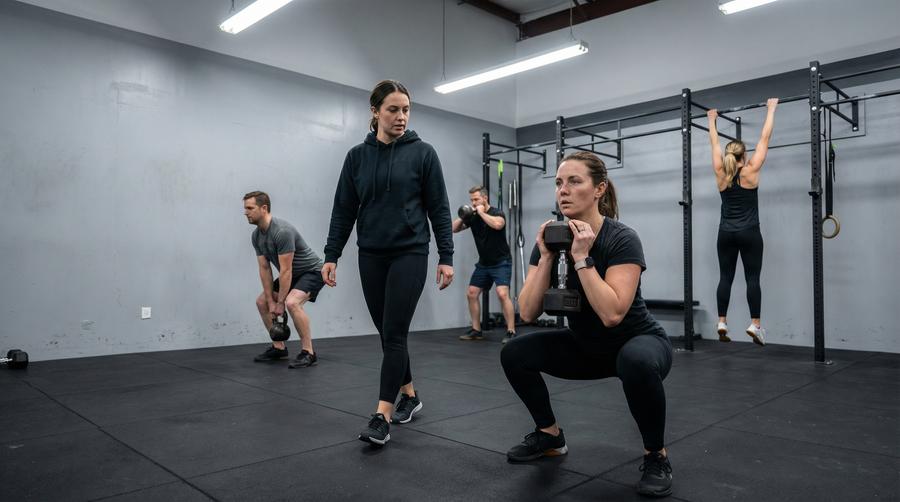
Technical intervention under fatigue. A squat at rep two looks different from a squat at rep eight. Coaches who only correct technique at the start of a set, when things look clean, miss the actual risk window. The intervention needs to happen when form breaks under fatigue — which requires the coach to be moving, watching, and ready to step in.
Scaling decisions on the fly. In a group, someone will always show up who can’t do the programmed movement as written. A coach who can offer a clean regression without disrupting the class, and do it without making the member feel called out, is managing the room well. That’s a skill that requires practice and clear pre-planned scaling options.
If your coaches haven’t been evaluated on these specific competencies, the coaching evaluation framework covers how to structure that assessment. What to look for is different by format, and strength has a different checklist than cycling or dance cardio.
The other thing worth naming: verbal-only instruction doesn’t hold up in a strength format the way it might in other classes. When members need to understand a movement pattern, see where their hips should be, or understand why they’re not pressing through the right part of their foot, words alone don’t do it. Demonstration and tactile cueing have a higher load in strength delivery.
What Good Looks Like Week to Week
A well-run group strength program produces observable, repeatable outcomes:
- Members can tell you what they lifted last week and what they’re targeting today
- The primary movements are consistent enough that form is visibly improving over the course of weeks
- Load is going up for most members who are attending regularly
- Coaches are making specific, individual corrections — not generic cues broadcast at the whole room
- Members who are new to strength training feel guided, not lost
If you sat in on your group strength class right now, which of those are true? Start there.
The Schedule Question
A group strength program also needs enough frequency to produce results. One strength session per week isn’t enough to drive meaningful adaptation for most members. Two is a reasonable minimum. Three per week, with adequate recovery between sessions, is where most people start to see consistent progress.
ACSM’s newly updated resistance training guidelines (2026, first revision in 17 years) back this up: “training all major muscle groups at least twice a week matters far more than chasing the idea of a ‘perfect’ or complex training plan.” That’s validation from the research community — but also a reminder that the bar for effective group strength programming isn’t as high as operators often assume. The problem most gyms have isn’t that their programming is too simple. It’s that the programming lacks consistency and the delivery lacks load management.
That has scheduling implications. If you’re currently offering one strength class per week and want to build a program around it, you need to add sessions — or convert existing format slots from cardio-dominant to strength-dominant.
That’s a scheduling audit question before it’s a programming question. A structured review of your group fitness lineup will surface which slots have room for reallocation and where demand already supports adding sessions.
The Point of Getting This Right
Members who are getting genuinely stronger will notice. The evidence is tangible: a heavier dumbbell, a cleaner movement pattern, a set that felt hard last month feeling manageable now. That feedback loop is self-sustaining in a way that cardio rarely is.
A member who has been coming to your strength class for three months and is visibly stronger has a reason to keep coming. Not just habit. Not just “I should exercise.” A specific thing they’re working toward, with a class that’s helping them get there.
That’s retention. And it’s built inside the class, not downstream of it. The instruction is the product — and in strength training, that product has a tangible output members can feel.
Related reading: The Workout Isn’t the Product. The Instruction Is. | How to Evaluate Your Coaches | Coaching Mixed-Ability Classes Without Losing Anyone | Your Class Is Only as Good as Your Warmup | Programming for Older Members Without Making It Feel Like Rehab