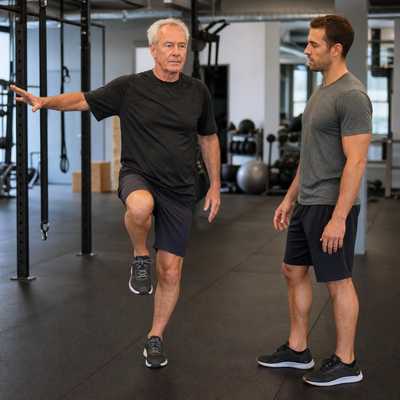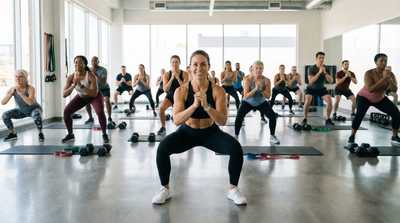
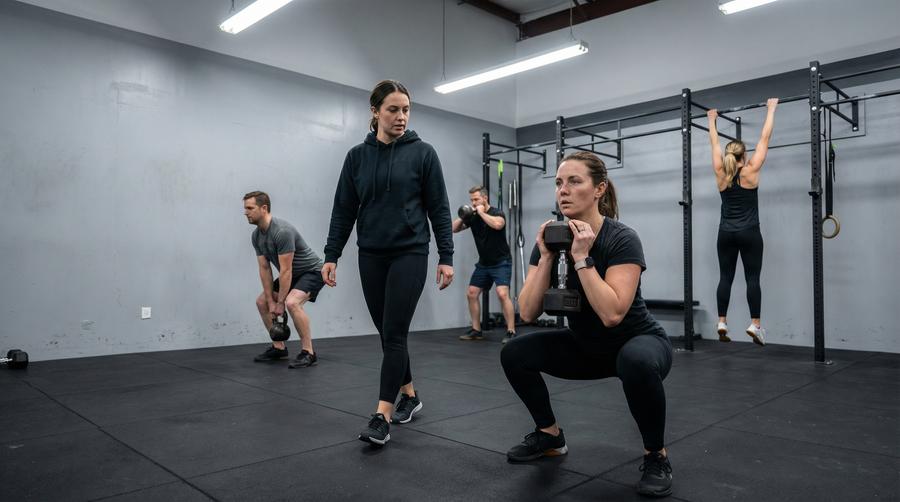
A group strength program should give members repeated opportunities to practice movements and track progress. A busy circuit can be useful, but sweating through a session doesn’t tell you whether strength is improving.
Start with repeatable exercises, individual load guidance, and a simple training record. Then check whether the timetable lets members follow the program.
When a circuit has no progression plan
Consider a full-body circuit using timed intervals, moderate weights, and a coach calling out rep counts from the front. Members are busy and sweating.
But the load is the same as it was six weeks ago. The movement pattern rotated this week, so members are doing a goblet squat instead of the Romanian deadlift they did last Thursday. There’s no record of what anyone lifted. No one is tracking whether the person in the back corner is any stronger than she was in January.
A circuit can improve strength, especially for beginners. Without a progression plan or records, however, the operator has little evidence of what members are building over time.
The distinction matters because members who are genuinely getting stronger will feel it. They’ll notice they’re picking up a heavier weight. They’ll see the bar moving differently. That feedback gives members something specific to work toward at the next session.
Why progressive programming is hard in groups
In one-on-one personal training, progressive overload is straightforward. You track what your client lifted last week, you add load or reps, you note what happened. The feedback is immediate and specific.
In a group setting, the variables multiply. You have twenty members with different starting points, different recovery rates, and different goals. The coach can’t track individual loads without a system. And the class format itself often works against progression: if the movements rotate every week, there’s nothing to build on.
The instinct is to simplify: pick accessible movements, keep the weight light enough that everyone can do it, keep the tempo high. That can make the class easier to run, but it also makes individual progression harder to plan and observe.
A group progression plan needs repeated movements, load guidance, and a record coaches can use.
What has to change
Anchor the program to a small movement library
Progressive strength programming doesn’t work with constantly rotating exercises. You need movement patterns that repeat regularly enough for members to actually improve at them.
One starting framework is four to six main movements repeated through a training block, often weekly. Adapt the frequency to attendance so members actually repeat them. Squat pattern, hip hinge, horizontal push, horizontal pull, carry. Members get competent at the movement, coaches can cue more specifically, and load can increase over time because there’s continuity to build on.
Vary assistance work, loading schemes, and rep ranges while keeping the primary movements in rotation long enough to practice them.
Give members a load reference point
A record makes progression easier to plan and review. Check whether your current format gives members a way to keep that record.
Options depend on how your facility is set up:
- An optional whiteboard where members comfortable sharing can record their working weight
- A simple sheet at the door, movement name, space for today’s weight
- A class-specific column in your gym management software if it supports it
- For smaller formats, a coach noting key members’ loads in a notebook or coach’s log
A reference point helps coaches distinguish a planned progression from a guess. Pick one that your coaches will actually use.
Design load ranges, not single prescriptions
“Use a moderate weight” is not a prescription. In a group of twenty people, moderate means something different to everyone in the room.
Effective group strength programming gives members load guidance based on relative effort, not arbitrary numbers. “A weight you can do for ten controlled reps while feeling able to do another two or three” is specific. It scales to the individual without requiring the coach to prescribe something different for every person in the room.
Rating of perceived exertion (RPE) and reps in reserve can help guide loading, but beginners may need practice judging effort. Coaches should check their attempts and adjust the starting load. If your coaches aren’t comfortable with RPE-based loading, that’s a coaching development gap worth closing before you add more strength sessions.
The coaching challenges are different
Delivering a group strength class well is a different skill set than delivering a group cardio class.
Different formats need different observation skills. Cardio coaching includes pacing, technique, and response to exertion. In strength work, coaches also need to assess whether the selected load and movement are manageable for each participant. An awkward repetition does not by itself predict injury; it is a reason to observe, ask, and adjust.
The skills that matter in a strength setting:
Load monitoring. Coaches need to scan the room and identify who is undertaxed, who is overtaxed, and who needs a load adjustment. This requires actually watching the work, not just cueing from the front.
Technical intervention under fatigue. A squat at rep two looks different from a squat at rep eight. Coaches who only correct technique at the start of a set, when things look clean, miss changes later in the set. When control deteriorates, the coach should help the member rest, reduce the load, or choose another option. Pain or concerning symptoms need an appropriate stop and response.
Scaling decisions on the fly. In a group, someone will always show up who can’t do the programmed movement as written. A coach who can offer a clean regression without disrupting the class, and do it without making the member feel called out, is managing the room well. That’s a skill that requires practice and clear pre-planned scaling options.
If your coaches haven’t been evaluated on these specific competencies, the coaching evaluation framework covers how to structure that assessment. What to look for is different by format, and strength has a different checklist than cycling or dance cardio.
Review the demonstration standard for movements that members find unfamiliar. When members need to understand a movement pattern, see where their hips should be, or understand why they’re not pressing through the right part of their foot, words alone don’t do it. Demonstration and individual feedback deserve time in the plan. Obtain consent before any hands-on guidance and offer a non-contact option.
What good looks like week to week
A well-run group strength program produces observable, repeatable outcomes:
- Members can tell you what they lifted last week and what they’re targeting today
- The primary movements are consistent enough that form is visibly improving over the course of weeks
- Members can identify progress in load, repetitions, control, or consistency; progress need not happen every week
- Coaches are making specific, individual corrections, not generic cues broadcast at the whole room
- Members who are new to strength training feel guided, not lost
If you sat in on your group strength class right now, which of those are true? Start there.
The schedule question
Make it possible for members to train major muscle groups at least twice a week, while allowing for their activity outside your classes. ACSM’s 2026 resistance-training update emphasizes regular training of the major muscle groups and individualizing the program to goals and ability. It also recognizes that moving from no resistance training to some can produce benefits.
Two well-spaced opportunities per week are a sensible base for a group program. Offer a third when demand and recovery support it. One weekly class can still help a beginner or complement training elsewhere; the timetable should make a consistent routine easier to build.
That has scheduling implications. If you’re currently offering one strength class per week and want to build a program around it, consider a second compatible slot, or help members fit the class alongside strength work they already do elsewhere.
That’s a scheduling audit question before it’s a programming question. A structured review of your group fitness lineup will surface which slots have room for reallocation and where demand already supports adding sessions.
The point of getting this right
Members who are getting genuinely stronger will notice. The evidence is tangible: a heavier dumbbell, a cleaner movement pattern, a set that felt hard last month feeling manageable now. Cardio can offer measurable progress too; the useful point is to make the outcome of this strength program visible.
A member who can see progress after three months has a specific goal to keep working toward and a class that helps them do it.
Visible progress gives members a reason to value the class, though it does not guarantee renewal. The instruction is the product, and in strength training, that product has a tangible output members can feel.
Related reading: The Workout Isn’t the Product. The Instruction Is. | How to Evaluate Your Coaches | Coaching Mixed-Ability Classes Without Losing Anyone | Your Class Is Only as Good as Your Warmup | Programming for Older Members Without Making It Feel Like Rehab