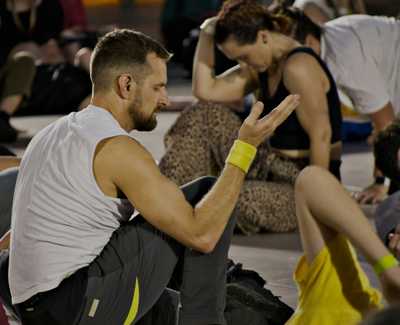

Here’s a number worth sitting with: 6.6 people in a group class.
In a November 2025 analysis, Two-Brain Business founder Chris Cooper cited that attendance figure from the firm’s State of the Industry report while making the case for small-group personal training. It describes the report’s gym data, not a worldwide census.
Now look at your own room. If you’re regularly coaching six people, offering individual feedback, and helping them progress, you may already be doing much of the work of a semi-private service. Is your pricing built around that work—or around the 20-person class you hoped to fill?
The Pricing Gap Nobody Talks About
Big group fitness pricing is built on a simple model: you spread coach cost across a large number of clients, which brings per-member cost down and makes the class accessible. It works at 18 people. It works at 25.
At six, you need to check the numbers again.
At six people, you have room to deliver a more personal product. The coach can actually see each person in the room. There’s enough space to give individual feedback. Members aren’t waiting for a rower or a barbell. The interaction is closer to personal training than group exercise.
The price needs to reflect the service you actually deliver. Six people following a shared workout isn’t automatically semi-private training. Individual plans, load adjustments, progress reviews, and reliable coaching contact are what make the higher-value offer credible.
Consider an illustrative AUD session: six members paying an effective A$20 each bring in A$120. After A$60 of coaching and A$10 of other direct costs, A$50 remains for rent and other overhead. At A$35 per person, revenue is A$210—but a more personal service also takes planning and review time. Price that work before counting the extra revenue as margin.
The point isn’t to charge more because attendance is low. It’s to stop delivering a deliberately personal service on a price that assumes far less coaching per member.
How This Happens
Most operators didn’t design their way into this situation. They built a group class model, grew it, and then watched attendance settle at a level that’s totally manageable but not what they imagined. The 25-person class they planned for became the 6-person class they’re actually running. The pricing never adjusted.
There are a few patterns that tend to produce this outcome.
Oversaturation of the schedule. Gyms that offer 15-20 classes per week often spread attendance thin across too many slots. Each individual class ends up smaller because the same members are distributed across more options. Consolidating your schedule can concentrate attendance in fewer, fuller sessions. The class schedule audit framework covers exactly how to run that review.
Mixed-goal formats. Classes that try to serve everyone (the beginner who wants coaching and the experienced athlete who wants intensity) often end up serving neither particularly well. Attendance stays modest because the product isn’t sharp enough to be someone’s primary training home.
Retention gaps. Classes stay small when members cycle through without sticking. If the first 90 days aren’t working (new members don’t feel seen, don’t build relationships, don’t feel progress), they leave before they become regulars. Small average attendance is sometimes a symptom of a retention issue upstream. The 90-day member journey is worth reviewing if that’s the case.
None of these are permanent. But they require different fixes, and the first step is accurately diagnosing which one applies to you.
Three Paths Forward
If your average class size is in the 4-8 person range, you have real options. Which path makes sense depends on your facility, your members, and what you’re trying to build.
Path 1: Stay Small, Charge Accordingly
The simplest option is to embrace what you’re actually running and reprice it. If you’re delivering a semi-private product (consistent small groups, high coaching contact, individual feedback, progressive programming), charge what that’s worth.
This can mean restructuring your membership tiers around a defined number of coached visits and progress reviews. Price the coach’s preparation and follow-up as well as the hour on the floor. Explain what changes for existing members and offer a workable transition; losing members affects the economics too.
Trial the offer with willing members before changing the whole business. You want evidence that they value the extra attention and that the fee covers the extra work.
Path 2: Grow the Group Intentionally
If big group is genuinely your model and you want to grow attendance toward 15-25 people per class, then treat that as an active project rather than something that will happen on its own.
Growing class attendance requires the same rigor as any acquisition or retention initiative. You need to know which slots have the most growth potential, which formats attract the most consistent members, and what the coaching experience looks like in those classes. Give members something specific to recommend: coaching they trust, a routine they can follow, and progress they can recognize. Then ask how new attendees heard about the class.
The programming quality question is relevant here. Group strength classes that are built around progressive overload give members a clear reason to return and build on the previous session. Members come back because they’re measurably getting somewhere. That takes programming and coaching time, but it gives your offer a purpose beyond filling an hour.
Path 3: Hybrid Model
A hybrid lets you keep a group offer while building a separate service for members who want more individual attention. The job is to make the difference clear enough that both products earn their place.
In practice, this might mean keeping 6-8 group classes per week as the accessible, community-facing product, while adding dedicated semi-private time blocks for members who want more coaching contact and are willing to pay for it. The two products serve different needs and different price points.
Plan the operational shift: dedicated time blocks, separate booking, and coaches trained to deliver the semi-private format well.
The Coaching Implication
One thing worth being honest about: smaller classes require more from your coaches, not less.
In a big group, a coach can manage energy from the front, keep the pace, and deliver a competent class without deep individual engagement. At six people, that approach is visible immediately. The coach who doesn’t know members’ names, doesn’t track who’s improving, and delivers generic cues to the room isn’t delivering what the format promises.
The skills that matter in small-group and semi-private settings are load monitoring, individual feedback under fatigue, and genuine relationship with each person in the room. If your coaches haven’t been evaluated on those specific competencies, the coaching evaluation framework gives you a starting point.
Worth noting: the instruction quality bar is also higher. In a room of six, verbal-only coaching doesn’t cut it. Demonstration and movement-specific feedback are part of the promise. If hands-on guidance is useful, ask first and offer a non-contact option.
What to Check This Week
If you haven’t looked at your actual class attendance data recently, this is the week to do it. Pull the last 60 days.
A few questions worth answering:
- What’s your median class attendance across all formats and time slots?
- Which classes consistently run under 8 people, and which run over 15?
- What are those small classes priced at, relative to what you’d charge for a semi-private session?
- Are those small classes growing, holding steady, or shrinking?
The answers usually tell you which path makes sense. Gyms with consistently small classes should check whether they are delivering enough individual service to support semi-private pricing, or need to improve the group model. Gyms with high variance (some classes packed, some empty) probably have a schedule structure issue.
Either way, the data will point you somewhere useful.
Price the Room You’re Actually Coaching
The small-group opportunity is close at hand when you already have six regulars who value the coach’s attention. You don’t need to pretend the room holds 25 people to build a viable service.
But make the promise explicit. What will each member receive? How will you track their progress? Can the fee pay for the time it takes?
If those answers hold up, small attendance can be a design choice instead of a disappointment. Charge for the coaching you can consistently deliver.
Related reading: Class Schedule Audit | Group Strength Classes That Build | Recovery as Revenue | Your Class Is the Check-In | How to Coach a Mixed-Ability Class Without Losing Anyone | How to Diagnose a Dying Class